Light at the Source: The UAE's Approach to Global Energy Access
Light at the Source: The UAE's Approach to Global Energy Access
Electricity changes how a place functions.
For communities that have lived without it, the shift is immediate but often understated. Lights that stay on, classrooms that extend beyond daylight hours, hospitals that can operate without interruption.
In November 2023, a floating solar power plant began generating electricity on the Cirata reservoir in West Java, Southeast Asia's largest of its kind. Built and operated by Masdar, Abu Dhabi's flagship clean energy company, the 145-megawatt facility now powers 50,000 homes and displaces 214,000 tonnes of carbon emissions every year. By April 2025, Masdar and Indonesia's state utility PLN had signed a further agreement to develop a second floating solar plant at the Jatigede Dam in West Java, with completion scheduled for 2027.
This is one expression of a much wider effort.
Today, 730 million people worldwide still lack access to electricity.The UAE's response to that gap has been structural, operating through two institutions that together cover the full distance from financing to deployment.
The Abu Dhabi Fund for Development (ADFD) has been the financing engine. Since 2013, through its partnership with the International Renewable Energy Agency (IRENA), ADFD committed USD 350 million in concessional loans across seven funding cycles, supporting 26 renewable energy projects in developing countries, unlocking nearly USD 870 million in total investment when co-financing is included.
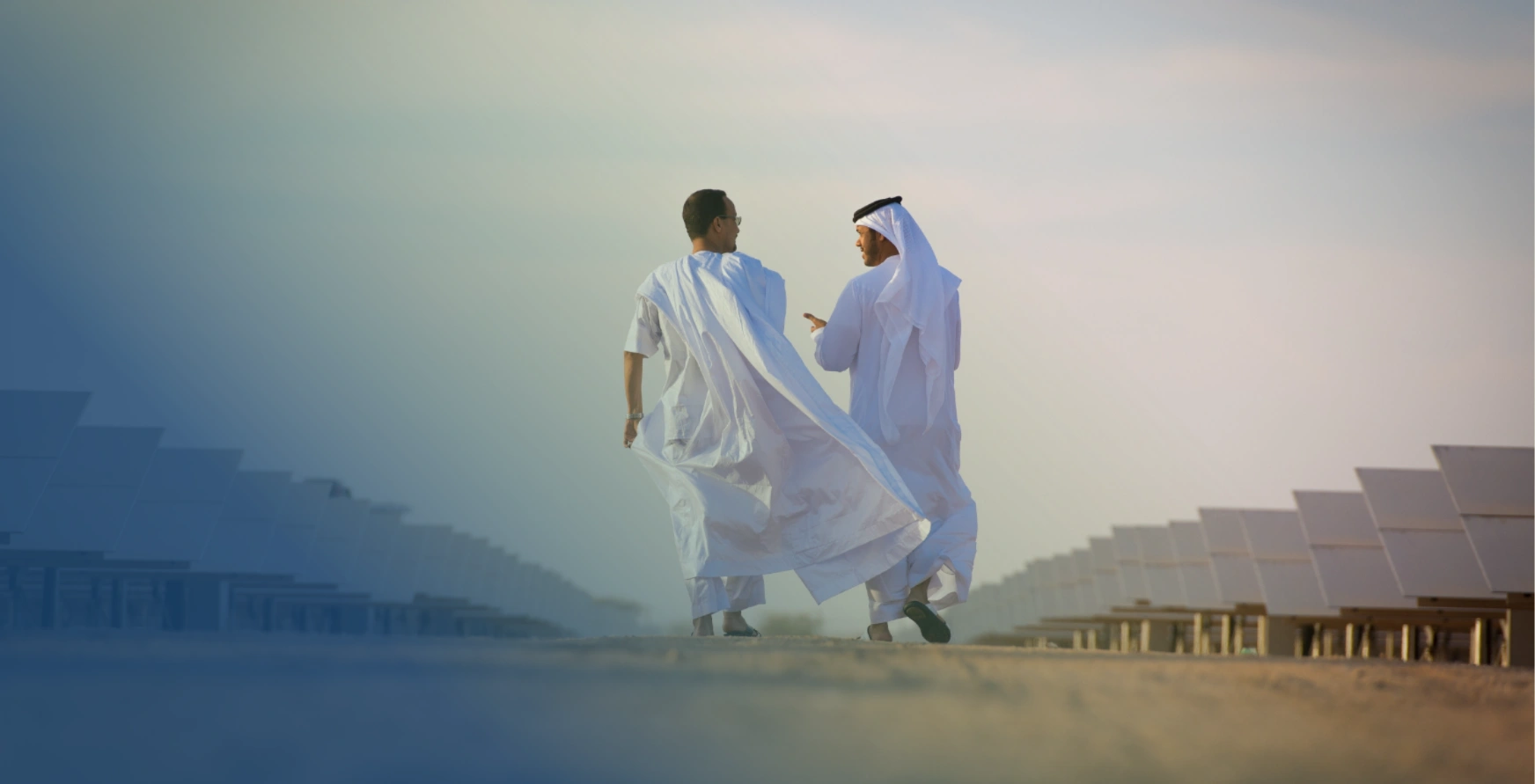
The projects span continents and technologies. In Jordan, ADFD financed a solar power complex in 2013, 100+ megawatts of solar capacity, 328,320 photovoltaic panels, powering more than 50,000 homes and reducing the country's dependence on imported fuel. The Jordanian government later renamed the complex Sheikh Zayed Solar Power Complex in honour of the UAE's Founding Father.
In Sierra Leone, the Solar Park Freetown, a 6-megawatt facility, also with the support of IRENA/ADFD, brought clean electricity to urban and rural communities around the capital for the first time. In Liberia, an $8 million loan supported a run-of-river hydropower plant on the Gee River, providing clean, reliable energy to over 30,000 people, households, schools, and health facilities included.
In the Seychelles, the partnership between ADFD and Masdar has produced two successive projects on the same island — first the Port Victoria Wind Farm in 2013, then the Île de Romainville Solar Park, a 5-megawatt plant with battery storage that saves two million litres of fuel annually and offsets 6,000 tonnes of CO₂. Together, they doubled the island nation's renewable energy capacity.
"By saving about two million litres of fossil fuel annually, the Île de Romainville solar PV plant will enable the country to significantly reduce its carbon footprint, provide a wide range of benefits to its people and empower small businesses.
— H.E. Mohammed Saif Al Suwaidi, Director General, ADFD
What connects these projects is not geography or technology, but method. Financing designed to be accessible. Partnerships developed with governments. Solutions adapted to local conditions, whether through floating solar panels in Indonesia, desert installations in Jordan, or hydropower in rural Liberia.
Masdar’s global renewable energy portfolio reached 51 gigawatts by the end of 2024, with a target of 100 gigawatts by 2030 across more than 40 countries. ADFD continues to direct financing toward energy projects in regions where access to capital remains limited.
It is a coordinated approach that works to close the distance between available technology and those who need it most, one project at a time.